Monday, February 10, 2014

O Mistress mine, where are you roaming? The Haunting of Hill House

O Mistress mine, where are you roaming? O stay and hear! your true-love’s coming That can sing both high and low; Trip no further, pretty sweeting, Journeys end in lovers’ meeting— Every wise man’s son doth know. - See more at: http://www.poets.org/viewmedia.php/prmMID/20239#sthash.NjbWYqvM.dpuf

 O Mistress mine, where are you roaming? 
O stay and hear! your true-love’s coming 
That can sing both high and low; 
Trip no further, pretty sweeting, 
Journeys end in lovers’ meeting— 
Every wise man’s son doth know
O Mistress mine, where are you roaming? O stay and hear! your true-love’s coming - See more at: http://www.poets.org/viewmedia.php/prmMID/20239#sthash.NjbWYqvM.dpuf
O Mistress mine, where are you roaming? O stay and hear! your true-love’s coming That can sing both high and low; Trip no further, pretty sweeting, Journeys end in lovers’ meeting— Every wise man’s son doth know. - See more at: http://www.poets.org/viewmedia.php/prmMID/20239#sthash.NjbWYqvM.dpuf

The Haunting of Hill House might be the only horror novel ever written that maintains the subtle cadence of a Shakespearean sonnet* for 182 pages. There is a lyrical push and pull quality to the prose that lulls you in like a wave, quietly rocking you almost gently to sleep and then eventually pulling you under. Half the time I was reading this book, I felt as though I were dreaming, as sentences like this washed over me:

Eleanor and Theodora reflected for a minute that it was imprudent for them to walk far from Hill House after dark. Each was so bent upon her own despair that escape into darkness was vital, and, containing themselves in that tight, vulnerable, impossible cloak which is fury, they stamped along together, each achingly aware of the other, each determined to be the last to speak. 

At times, the interiority of it all becomes a bit too much to bear. There are moments when Eleanor's mousy insanity gets a bit tiresome. When I first read the book, in high school, I thought Theodora very cruel toward Eleanor, but this time around I understood her impulse to want to slap some confidence into Nell every so often. All that emotional fragility is so exhausting. (Perhaps the ultimate horror here isn't the super scary dream house -- maybe it's that the paranoid feeling you have that no one likes you and you're an irredeemably irritating person might be because... no one likes you and you're an irredeemably irritating person. At first Eleanor can play the game, she can socialize and banter with the rest of them, but then her essential separateness, her essential insanity, breaks to the surface and everyone realizes she's a complete bummer and they really just want her to go home. Think on that next time you're mingling at a cocktail party.)

Obviously, Hill House utilizes incredibly psychological horror, and every once in a while you wish Jackson would use her astonishing abilities to make something happen. There's so much sitting around drinking brandy. But it's all about relationships, isn't it? On my first reading of the book, it was the relationship between Eleanor and Theodora that stuck with me. The subtle and terrifying entanglements of the female dynamic certainly resonated with me in high school, where every day brought fresh complexities and betrayals. Naturally, I understood Eleanor's compulsive attraction to the house; it is the one rule of Hill House that everyone understands when almost nothing else about the house is comprehensible or in any way assured. The original Times review even suggests the possibility that Eleanor is not at the house at all: "A disquieting doubt is sown in the reader's mind. Is Eleanor at Hill House or not? If there, how is she there?" All of which is to say, there is a lot of dancing around the interpersonal dynamics of the house, much interior monologuing inside Eleanor's fragile, tortured mind, and plenty of ambiguous exploration of the house and grounds, but mostly there is a lot of waiting around. (Also: Theo is a lesbian, right? Another thing I missed on the first reading. If not, why the genderless live-in "friend"? Discuss.)

In a sense, Hill House is the complete antithesis of Rosemary's Baby, which I read last week, where action takes precedence over language. In Hill House the writing is almost the only thing that matters, because very little happens. To be clear, the waiting around is exquisitely wrought, but it is just a hair short sometimes of being too subtle, too restrained. Luckily, this is Shirley fucking Jackson we're dealing with here, so she pulls it off. Yet oddly I feel Hill House is a lesser book than Jackson's other classic, We Have Always Lived In The Castle, which managed somehow to do more, to deliver more intensity.

Still. Those moments where Jackson does indulge us in a little ghostly action are absolutely masterful. As a writer, the reason I re-read this book was to try to unlock the secret to writing a masterful horror novel (easy, right?). And I realized the answer isn't in parsing the structure of the book -- it's about reading every single word. It reminds me of an old joke I heard once about how to write a winning screenplay: it should be 90 to 110 pages, have three holes punched in the side, secured with two brads, and also it should be written really, really, really well. So, for those also hoping to learn how to do it, here's how:

Sitting up in the two beds beside each other, Eleanor and Theodora reached out between and held hands tight; the room was brutally cold and thickly dark. From the room next door... came the steady low sound of a voice babbling, too low for words to be understood, too steady for disbelief. Then, without warning, there was a little laugh, the small, gurgling laugh that broke through the babbling, and rose as it laughed, on up and up the scale, and then broke off suddenly in a little painful gasp and the voice went on.

Jackson goes on to describe the sobbing, babbling, laughing voice, which tortures Eleanor until she screams, "STOP IT!" and then --

The lights were on the way they had left them and Theodora was sitting up in bed, startled and disheveled.
"What?" Theodora was saying. "What, Nell? What?"
"God God," Eleanor said, flinging herself out of bed and across the room to stand shuddering in a corner. "God God -- whose hand was I holding?"

So yeah, that's how you make a reader feel terrified and insane. Like I said, easy.

Perhaps significantly, when it comes to the moments of ghostly action, Jackson seems to take her cues from the incidents at Borley Rectory -- most obviously the writing on the walls -- which were later discredited. I wonder if they were still widely believed true in 1959 when Jackson wrote Hill House; if not, that's just one more layer of subtle trickery.

One final note: on this reading, I also found myself unexpectedly amused by the blast of air that was Mrs. Montague, a paranormal blowhard who rushes into the house with all the grace of a tornado (and ends up befriending the dour and impossible Mrs. Dudley!). I loved the shift in tone and perspective she brought with her, setting everything as askew as Hill House itself, which, by the way, we are told is all askew and yet upright and solid at varying points in the book. (Nothing is what it seems!) Jackson has enough humor and self awareness to allow moments like Mrs. Montague's into her narrative.

Only Shirley Jackson could take an old dark house tale and do this with it. Even if the book, like Eleanor, does have its (very) occasional wearying moments, ultimately there are moments of absolute horror, which Jackson sprinkles throughout the book in vast enough quantities to keep us from sensing that there is no action at all. The doctor, after one of the first real incidents at the house, notes, "When Luke and I are called outside, and you two are kept imprisoned inside, doesn't it begin to seem" -- and his voice was very quiet -- "doesn't it begin to seem that the intention is, somehow, to separate us?" For this, and for bestowing on the world the vague and shadowy character of Eleanor Vance, Jackson will forever be the master. No reader, once having read her, will ever forget Eleanor.

Eleanor who roams forever, mistress of Hill House, her only beloved.

*Are these lines actually a sonnet? I'm not sure.

Friday, February 07, 2014

A Bunch of Not-Very-Bright Bitches: Rosemary's Baby, Structure and Criticism

"One of the half-dozen most influential horror novels of all time."

Today: part two in our look back at classic horror novels! 

When it comes to Rosemary's Baby, the movie gets a lot more attention than the book. The film is widely considered a classic, while the book is thought a flimsy bit of long forgotten pulp trash, whose own author almost disavowed it, even going so far as to blame it for the dumbening of America. But if you take the time to go back and revisit it, not only is it a snappy little read with a wry, mordant, ironic sense of humor, it's also a minimalist marvel of structure, characterization, and efficiency, expertly executed by a playwright and craftsman.

Like most people trained to write for stage or screen, Ira Levin was more about structure than style. This is something certain literary types will made snide comments about, or (worse) praise faintly. But Otto Penzler gets it. In his introduction to the novel's 2010 edition, the mystery master perfectly sums it up: Levin's sentences are "models of precision, making up what they lacked in velvety, mandarin, overripe prose with clarity and forward movement, with never a wasted word."

I recently sat down and did a structural analysis of novel and if you'd like to know how Levin pulls it off, here it is. For those who are not horror or suspense writers, feel free to skip the next section.

A Structural Analysis 

Let's start with characterization. In chapter one, we already learn that Guy is a good liar, and that Rosemary is sweet, and a people-pleaser. We learn this in the brief interaction between Guy, Rosemary, and a couple of real estate agents. In addition to characterization, a lot of really important exposition is delivered through dialogue, which might seem easy and obvious but then Levin gets ingenious with it, actually delivering expository information through half-heard bits of conversation floating through Rosemary's dreams. The walls in her apartment are thin, you see, and she can hear the Castavets plotting right through them... but of course she doesn't yet make the connection.

With Levin, everything -- especially set ups and characterization -- comes down to individual, granular moments. Let's take the famous sandwich scene in chapter five. Husband of the year candidate Guy takes a sandwich and beer supplied by Rosemary without even saying thank you. Levin uses this scene to advance the action (Rosemary says they have been invited to dinner at the Castavets), to establish character (Guy = thankless dickwad) and set up Guy's frustration with his career, which makes what happens next plausible and believable. (Side note: this is why I have such issues with the excessive word-count phenomenon I see going on in so many contemporary novels. You don't need a hundred pages to show us that Guy is a dickwad. You just need one sandwich.)

The fantastic part about the plotting in Rosemary's Baby is that everything evolves through action. You can practically feel the story beats lining themselves up in a row, but they're never obvious. In one scene, Guy is pondering the Castavets' scheme. How do we know this? He's up late at night, smoking a cigarette. That's it. That's all it takes. At the time, on the first read, you might not even notice it. But later, when the story starts paying off, you realize what a subtle set up it was.

Later, Guy gets real close to blowing the whole act when he lashes out at Rosemary after the party scene, after she got some very sane advice from her girlfriends, calling them a “bunch of not-very-bright bitches who should mind their own god-damned business,” and dismissing Dr. Hill as a Charley Nobody.

Rosemary objects: 

“I’m just going to let Dr. Hill examine me and give me his opinion.”
“I won’t let you,” Guy said. “It’s -- it’s not fair to Sapirstein.”
“Not fair to -- What are you talking about? What about what’s fair to me?”

So Levin steps back and has Rosemary’s pain suddenly, inexplicably disappear. It’s not time for that crisis yet, not if we want to keep stringing this girl along, anyway. No, Rosemary won’t show another flash of anger and insight until after Hutch’s death, when she reads the book All of them Witches. Of course, at that point we realize C.C. Hill isn’t quite the dreamboy of the western world after all, when he sells her straight down the river. 

Speaking of Hutch, here’s another great example of how Levin strings us along with little breadcrumbs throughout the book. A chance conversation with Hutch’s daughter at the hospital informs Rosemary that she (Rosemary) is seeing Dr. Sapirstein about twice as often as an ordinary woman. It will also be a chance moment at the Doctor’s office that will tip her off to his frequent and smelly use of the tannis root. Levin does rely a little bit on coincidence -- for example, having Rosemary run into Guy’s vocal coach and discovering about the Fantasticks tickets -- but only these three times by my count, which isn’t outside the realm of probability.

Finally, Levin is great at lulls. Almost all of chapter six in part two is just Rosemary being happy, and even after Hutch dies and she finds out about the witches, there is a lull where things seem smoothed away. Even after the iconic hot-phone-booth suspense scene, Rosemary has a chance to lie down in a cool room… until they take her away.

So basically, Levin does everything you’ve ever been told to do while writing suspense: he "shows us the gun," he lets us stay one step ahead of the main character (but not two), and he litters the trail to the climax with lots of little bread crumbs. Yet, incredibly, the book doesn’t feel overly plotted. One thing Rosemary’s Baby has in common with the Exorcist is the simplicity of its concept. I also notice that Levin uses -- probably unknowingly -- many of the principles M.R. James suggests for writing good horror. He keeps the setting modern, and banal (for realism), proceeds slowly, keeps his evil pure evil, and when he’s ready to (usually between chapters 7 and 10), delivers an eminently “Jamesian wallop.” Levin observed that “the most suspenseful part of a horror story is before, not after, the horror appears,” which also explains why act three is less than a quarter of the length of acts one and two. No need to linger once the act is done.

Incidentally, pregnancy itself is also a simple concept -- from month one to month nine, a small human being develops. It’s how that tiny person develops that’s really amazing. Levin said, “I was struck one day by the thought (while not listening to a lecture) that a fetus could be an effective horror if the reader knew it was growing into something malignly different from the baby expected. Nine whole months of anticipation, with the horror inside the heroine!”

It’s simplicity itself. I wish more horror writers, readers, and critics would learn to appreciate this concept. Elaborate plot twists are not always necessary. If there’s one criticism that almost always strikes me as meaningless, it’s “I saw that coming.”


Criticism 

Interestingly enough, almost none of the criticism of Rosemary’s Baby deals with the fact that nothing in it is really unexpected, except, strangely, Renata Adler’s (!) original review of the film in the New York Times: "The movie—although it is pleasant—doesn't quite work on any of its dark or powerful terms. I think this is because it is almost too extremely plausible. One gets very annoyed that they don't catch on sooner. One's friends would have understood the situation at once."

I really wish the producers had gone with this for a movie poster pull-quote: “Rosemary’s Baby is …. pleasant.” - Renata Adler.

But I promised to talk about the book, not the movie, so let’s see what the paper of record had to say about the novel, shall we? In Thomas J. Fleming’s original 1967 review, he catches on immediately to how great the story concept is:

"Ira Levin has 'urbanized' the ghost story. Instead of a creepy mansion on a windy hill, he has given us a haunted apartment house on upper Seventh Avenue. Into this highceilinged warren (with its vaguely sinister gargoyle facade) move Rosemary and her actor-husband, Guy."

And he loves at least the first two thirds of the book: "Mr. Levin’s suspense is beautifully intertwined with everyday incidents; the delicate line between belief and disbelief is faultlessly drawn."

But he hates the ending -- though not because he saw it coming. He seems to hate the ending because he saw it:

"Up until this point, we are with him entirely, admiring his skill and simultaneously searching out possible, probable, and improbable explanations of how he is going to extricate his heroine. Here, unfortunately, he pulls a switcheroo which sends up tumbling from sophistication to Dracula. Our thoroughly modern suspense story ends as just another Gothic tale.
Riding high on the jacket is a quote from Truman Capote comparing Rosemary’s Baby to The Turn of the Screw. Alas, this is precisely where it fails to measure up. James knew too much about the ambiguities of reality to make us decide whether his terror emanated from the supernatural or the torturous, unexplored depths of the human mind."

Fleming deplores the “literal resolution” of this story, demonstrating a failure to understand the pleasures of the horror genre -- but then, this is a guy who thinks a comparison to Dracula is a mild insult.

Personally, I think Rosemary’s Baby is a bit like Rosemary herself. People think she was stupid, but she wasn’t. She was a lot smarter, and a lot more self aware than people remember. She read the Decline and Fall of the Roman Empire for fun, and she was really good at Scrabble. Don’t underestimate little Rosemary Reilly from Omaha. She might just end up in charge of your whole god damned coven.

Monday, January 27, 2014

Revisiting the Classics: The Exorcist, Rosemary's Baby, and The Haunting of Hill House

A supernatural mystery

I've been on a bit of a re-reading rampage lately, and I just finished Rosemary's Baby for the fourth or fifth time. I've written (shallowly) about the film adaptation of Rosemary in the past, but it's been extremely enlightening to revisit the book again and re-examine it on a structural level. The Haunting of Hill House is sitting on a side table as we speak, awaiting my second reading, and I reckoned since I was burrowing back into mid-century classics I might as well check out the Exorcist too because I've actually never read it. These days I'm a bit less snobbish than I used to be, so I thought I'd give it a whirl. Joke's on me, I read the thing in about two sittings, and I not only enjoyed it, I cried once. So there.

Disclaimer: I read the 40th Anniversary Edition of the Exorcist, which was supposedly edited and more polished than the original novel (Blatty claims he wrote the first book fairly hastily). Maybe the original edition is completely different -- apparently he even wrote a whole new character for this new version -- so if you have read the original and want to shed any light here, feel free to chime in.

To me, the most surprising thing about The Exorcist was how incredibly procedural it is. That, and the almost stunning detachment of the writing. The plot points mirror those of the film, but when you're not being accosted by all the visual spectacle of the barfing and the head-turning, you really notice how methodically the story proceeds from the physical to the mental to, ultimately, the spiritual. Regan, when her symptoms first manifest, undergoes a series of tests -- MRIs, blood tests -- but when these come up short, her doctor suggests she may be suffering from dissociative or perhaps multiple personality disorder. It is only when these diagnoses also fail to explain the incredible occurrences in the MacNeil household that her mother Chris turns to Father Karras for help. Body, mind, soul. It's quite neatly executed in the book, and above all logical.

Father Karras is also far better in the book. Jason Miller in the film adaptation was so totally overshadowed by the dominant disembodied voice of Mercedes McCambridge, the poor guy never stood a chance. But in the book his backstory is actually story, and it's fairly devastating. Karras' recollections of his abysmal childhood in New York City, when his mother actually went out into the streets to beg because they were so poor, are shattering (this may have been the part where I cried). The moment when he's taking the subway and a drunk says, "Spare a dime for an old altar boy faddah," is an eerily dreamy flashback overlayed with profound melancholy, memory, and grief. Really! His struggles with his loss of faith are believable, harrowing, and utterly human, as is his warm friendship with the police detective in charge of investigating Burke Denning's death. In fact, a lot more time is spent trying to figure out who killed Dennings in the book -- there are even a few red herrings tossed in, in the form of the MacNeil's surly Swiss butler, Karl. Reading it, I was struck by something: this is a supernatural mystery!

I was truly surprised to find that much depth in a book I figured would pretty much just be exploitation. On that front, I was amused to find the writing not in the least salacious. The most graphic and perverse scenes that you all remember from the film are described with as much prurience as a first year obstetrics student describing his daily rounds. Things get thrust into places, there is blood. Bodily effluvia is duly described. Either Blatty was consciously avoiding the possible accusation of exploitation (or even pornography) or he was just trying to bang out the crucifix scene before lunch.

In interviews, Blatty says he "actually didn't mean to make the book as scary as it turned out. Instead, it was meant to be a novel about faith, in which Father Karras' beliefs are tested by Regan's possession." Some fans are incredulous, but I can kind of believe it. According to the L.A. Times, Blatty said, "When I was writing the novel, I thought I was writing a supernatural detective story that was filled with suspense with theological overtones." I'd say that definitely comes across when you read the book, though again maybe it's only in the 40th anniversary edition.

But the experience of trying hard to write one type of book and ending up with another? I feel ya, Blatty. I feel ya. And if anybody's interested, I've got a manuscript of a tense Girl With The Dragoon Tattoo-esque thriller you might be interested in reading. Apparently, it's hilarious.

Stay tuned for parts two and three of Revisiting the Classics: Rosemary's Baby, and The Haunting of Hill House.

Monday, June 17, 2013

Spinster Travelogue: Sleepy Hollow

This weekend I took a spur-of-the-moment visit up to Tarrytown and Sleepy Hollow. Incredibly, I'd never been before -- which, for a Washington Irving fan and ghost tour guide, is somewhat shocking. I was so excited to finally, finally see Tarrytown (!) that, on the train, I clutched my ticket like a child until the Metro-North conductor looked and me and kindly inquired if I got out of the city much.
Other than one minor disappointment (there was no lantern-light cemetery tour offered on Saturday night; I soothed my sorrow at a nearby tavern), the trip was awesome.
Old Dutch Church
The Old Dutch Church in Sleepy Hollow
Hymns were wafting out of the Old Dutch Church when I arrived at ten o'clock on Sunday morning. The church itself is beautiful; you can easily imagine the secrets and sights absorbed into its worn stones.
Dutch Church Sign
A grammatically baffling yet nonetheless soul-stirring sign.
Afraid of disrupting the service, I was too timid to actually go inside the church. But the adjacent burial ground was rich enough with delights.
Dutch Grave 1769
"Here Lied Begraven"
I'm pretty sure the first three words carved onto this stone are "Here Lied Begraven." The text is in Dutch, which is thrilling enough (they spell Jesus with Z!) but I have to say the word "begraven" is kind of amazing. I'd like to start using this word all the time. I'm fairly sure the grave belongs to a woman ("huisvrouw," if I've been reading my Knickerbocker correctly, means "housewife" or "wife") but the only name that appears is that of a man (John Emers). Is it possible this goodly vrouw is identified only by her husband's name? Dutch people, help me out on this one. The good woman died in 1769, and her headstone is wonderfully representative of the preferred colonial style: its shoulder arches and tympanum are classic colonial, and the winged death's-head reflects the cheerier, more cherubic design used at the time, which supplanted the grim, skeletal carvings preferred in the earlier part of the century. A lovely headstone.
Irving Grave
Washington Irving's Grave
A few steps away, I found the grave of our man himself: Washington Irving. I paused before it to pay my respects to the legacy of the first genius of American letters, and left a rock atop it. Irving wrote a number of wonderful spectral tales in addition to the two everybody knows, as well as history, biography and satire, plus he pretty much single-handedly saved Christmas. And, he was a marketing genius. Prior to publishing his History of New-York, which he released under the pseudonym "Diedrich Knickerbocker," Irving plastered New York City with posters declaiming the august historian Knickerbocker "missing," and asking all citizens to come forward with any news of him, should they find him. Irving even took out ad space in various newspapers. Naturally, the city was astir with curiosity, and when "Knickerbocker's" book finally came out a few weeks later, New Yorkers beat down the doors to get their hands on a copy. A bestseller was born, and Washington Irving accidentally invented viral marketing two centuries before such a thing existed.
Headless Horseman Bridge
But of course Irving's masterwork was his Legend of Sleepy Hollow, and as thrilled as I was to find the author's grave, I have to admit the biggest frisson of the day came when we drove over the bridge supposedly referenced in the story. The bridge is just outside the churchyard gates, and on the day we visited, two volunteers had set up merchandise tables there. As I seriously pondered buying a pewter Headless Horseman Christmas tree ornament, the older gentleman volunteer began speaking passionately about how much he loved the churchyard, and Irving, and the stories. He quoted some lines from Sleepy Hollow to us:
An opening in the trees now cheered him with the hopes that the church bridge was at hand. The wavering reflection of a silver star in the bosom of the brook told him that he was not mistaken... “If I can but reach that bridge,” thought Ichabod, “I am safe.”
He looked at us intently and said, "That line always makes my hair stand up."
Restored Bridge
A re-creation of the bridge, inside Sleepy Hollow Cemetery.
It was amazing. This guy was an even bigger Washington Irving fan than I was. I thanked him warmly and, brimming with inspiration, set off to visit Sunnyside.
Sunnyside was designed by Irving himself, and the cottage reflects the writer's expansive and wide-ranging interests. It has all the architectural cohesion of a minor explosion, and is curiously charming.
Sunnyside
Sunnyside
Irving of course had to throw in a few inauthentic faux-Dutch touches, like this date, affixed to the western wall of the cottage:
This house was actually built in the 1840s.
This house was actually built in the 1830s.
The funny thing is, no one is really sure what the "1656" refers to. Obviously it doesn't reflect the date Sunnyside was built, since Irving bought the land in 1835. Nor does it refer to the original tenant farmer's cottage that was previously on the site (it was built in the 1690s). I asked the guide and he surmised Irving just wanted to add an old-timey touch to the place. It seems the great writer left us one last mystery. Or, knowing the author's whimsical sense of humor, one last joke.

Friday, March 29, 2013

Terry McGarry to read M.R. James and Heads Will Explode

Mainly, my head.

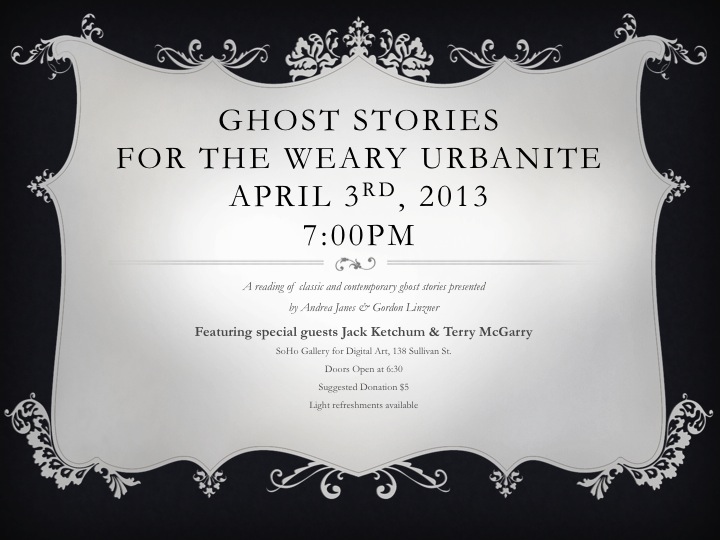
Next week I will be co-hosting Ghost Stories for the Weary Urbanite, a fun show with a poncey title that will feature one new and one classic ghost story. The new story will come courtesy of Jack Ketchum, and the classic story will be read by the lovely Terry McGarry.

Here's where the head-exploding part comes in: this stellar SF author will be reading one of my favorite ghost stories of all time: Lost Hearts, by M.R. James.

My love for M.R. James is a tired old subject I won't bang on about any more, but let me just say for the record that this is a very thrilling announcement for me to make.

If you haven't read it yet -- don't! Come out on Wednesday April 3rd to hear Terry read it to you! Unless you live nowhere near New York City, in which case I'd recommend the next best thing: the M.R. James Podcast to the Curious. Or, you can do it the old fashioned way.

Hope to see those of you who can make it at this event. We plan to make it an ongoing thing, and the thought of contemporary horror authors gathering 'round to read the classic tales that inspired them, well, it makes me glow like some sort of very hot glowy thing.

Love,

SA

Monday, March 25, 2013

Ghost Stories for the Weary Urbanite

Ghost Stories Flyer Text Only

Next Wednesday, April 3rd, I’ll be co-hosting (along with Gordon Linzner) a night of readings of classical and contemporary ghost stories, with special guests Jack Ketchum and Terry McGarry. Ketchum and McGarry are renowned horror/SF writers, and this is an amazing chance to see them together! So, to paraphrase Lord Dunsany, come with me ladies and gentlemen who are in any wise weary of New York,  “Come with me, and those that tire at all of the world we know: for we have new worlds here.”

Readings will take place at the SoHo Gallery for Digital Art. Doors open 6:30pm. $5 donation requested. For more information, check out our Facebook page.

Sunday, March 24, 2013

Brooklyn Ghosts: Cobble Hill

Found this great post over at the Bowery Boys, telling a Brooklyn ghost story I’d never heard before. And it’s thoroughly awesome.


According to Henry Reed Stiles’ 1869 history of Brooklyn, the following event transpired one night in the 1820s, in a rowdy little tavern on Red Hook Lane:

“One evening at around 11 p.m., the men at the converted tavern discovered they had run out of brandy.  To replenish their supply, somebody needed only to run down Red Hook Lane to the Brooklyn ferry and retrieve more. 

Less than a half-mile walk, of course, but one that passed by an old ruined fort (Cobbleshill Fort), approximately near the intersection of today’s Court and Pacific streets.  Sitting near to the fort was “a ghost-haunted spot,” a frightening, decrepit place well-known to locals, ‘about which dreadful stories are whispered, which lent wings to the feet of such unwary village urchins as chanced to pass it after dark.’

Nobody wanted to admit they were frightened to venture out alone, and yet despite their incredible thirst, nobody volunteered for the task.  Finally, a man named Boerum, thirsty and bold, declared he would head to the ferry and retrieve the brandy.”

Two hours later, when Boerum still had not returned, his friends ventured forth into the night, all a-tremble with terror and trepidation:

“Mounting, not in hot haste, they turned their horses’ heads towards the village and on approaching the haunted ground, they found Boerum’s horse standing against the fence not far from the house, and when they reach the spot itself, their companion was discovered lying senseless on the road, with features horribly distorted.”

Boerum died a few days later, still speechless, and to this day nobody knows how he perished. Did he see the ghost and die of fright? Or did he come across something still more sinister?
We cannot say. But you can still visit Red Hook Lane, a tiny alley in Cobble Hill, just off Fulton Street, and see if the spirits will tell you anything.

Read the rest of the Bowery Boys blog post here.

Wednesday, February 20, 2013

Well, this is a whole lotta crap: Detox Diary


I recently decided to go on a beer detox, just to see what would happen. Part of me was simply experimenting, setting a pointless challenge for myself, which is a thing I do sometimes for some reason. Another part of me realized that the heroic amounts of beer I consume on a regular basis might make me an educated consumer, passionate beer enthusiast, and generally happy and satisfied person, but it was also making my tummy start to hurt. Now, I'm no scientician. I'm not even sure where in the human body the liver is located. But I knew that my liver was politely asking me for a little break.

And so I decided it was time for the Homer Challenge: No Deer For A Month.

Naturally I assumed that everything about my mind and body would immediately become awesome right away. I'd bound out bed in the mornings, a monster of clarity, efficiently performing tasks and activities with ease and grace. I'd remember things like names and faces, my IQ would jump ten points, I'd drop a ton of weight without trying, and my skin would look fresh and hydrated!


Nope!

Here's what's really happening:

1. Cognitive function not improved

By any measurable standards, I'm just as dumb as I was a week ago. I have signed up for Lumosity, so I'll be tracking this on a quantifiable level. But, anecdotally, I can say I'm not finding it any easier to learn or retain new information, nor am I finding my reaction time, speed, attention, or any other function significantly improved. In fact, due to the extreme stress of staying sober, I am actually doing worse at certain activities. Case Study #1: Total crap at pub quiz last night. My hypothesis? When you're relaxed, you perform better at everything. When you're drinking soda water with lime, you are not relaxed, therefore you arse up the pub quiz and forget things like the fact that Alfred Nobel invented dynamite.

Beer: 1
Temperance: 0

2. Still fat

Actually, I'm exercising less now than I did when I enjoyed a beer or two with dinner. Back then (a whole long week ago!) I'd try so hard to exercise those calories away that I'd end up doing lots of cardio. These days... meh.

Beer: 1
Temperance: 0

3. ANGRY

Man, am I irritable! I want to slap everyone I see. I'm constantly twitchy, impatient, and annoyed. Everyone's enjoying themselves but me! I even got into a fight at the aforementioned pub last night over a question on the quiz. I was right, and no one else could see that except me! Because everyone is drunk and stupid and doesn't care about the really important things like FACTS and RULES! God damn it!

Beer: 1
Temperance: 0

4. Insomnia!

Fact, hops make you sleep. A nice IPA in the evening was just the thing to cure my insomnia. I slept the sleep of the just. These days I toss and turn until three in the morning. Ironically, sleep deprivation results in the cognitive equivalent of consuming three to four drinks, so therefore this morning I am about as alert and refreshed as a very hung over person. It's all punishment, no fun, up here in the big ole sober house.

Beer: 1
Temperance: 0

In conclusion, this is bullshit.*

However, I'm determined to stick it out for the full month and, who knows, maybe everything will become amazing in, like, a week or so. But I'm pretty much ready to conclude at this point that beer really is proof that God loves us and wants us to be happy (I know Benjamin Franklin didn't actually say that, but who cares, because facts are totally fungible and open to interpretation, according to the stupid moron who runs the stupid trivia pub quiz) and that teetotaling is for the weak.

The one good thing I have to say about all this is I think it's making me a better taster. I did have some Fruet this weekend, because when someone opens a bottle of that shit, all bets are off, and I think I was more sensitized and attuned to flavor nuances after my brief drinking break. In three weeks, when I return rested and refreshed from my beer exile, I think I'll notice and taste things in ways I never picked up on before. All of which will make me a better drinker... so nothing is wasted, really. So to speak.

* Just want to go on record and say that I intend this all from a personal standpoint, and of course if you have an actual substance abuse problem then Beer = minus a million points and Temperance = plus one billion. 

Wednesday, January 23, 2013

Mama (2013) Mini-review


In the midst of January's cinematic dumping-ground comes a solid and well-crafted ghost story, marred only by a few strange aesthetic choices: Mama (2013). Exec produced by Guillermo del Toro, the film was based on Barbara Muschietti 's 2008 Spanish language horror film of the same name in a bit of a dream-come-true scenario ("Hey, del Toro likes your short and wants to finance a feature. Sound cool to you?"). It's a satisfying film overall but with a few flaws that marred the final product.

The set up is fundamentally brilliant: two little girls, aged three and one, are abandoned by their psychotic father in a cabin in the woods. Their daddy's gone crazy and killed their mother, and he's about to shoot the oldest girl when a mysterious, ghostly entity snatches him up, takes him away, and saves the children. The two girls grow up feral and alone, watched over only by the ghostly presence who they call "Mama." When their uncle finally finds them five years later, the older girl is willing to become part of the society of the living, but the younger daughter, who never really learned to speak and is far more savage than her sister, remains attached to her death-mommy. If you happen to be a Freudian, you'll find their ages quite significant. But even if you're not, the dark fairy-tale evocations of the cabin in the woods, mixed in with some of horror's most effective, if well-worn, tropes (the uncanny child, gruesome motherhood) combine to create one unsettling experience.

While the story, lead performances and characterization, are all great, the ghost itself was a bit problematic for me. The apparition was just so badly rendered, the worst of the worst CGI. In the course of the film, certain photographs are used to illustrate Mama's origin story; these look a bit like Victorian spirit photos or death portraits, and are far scarier than the final CGI specter. Visually, a little less-is-more might've saved that ghost. 

Otherwise, Mama was a solid film, with a surprisingly -- and refreshingly -- bleak ending. It was certainly effective enough to give me nightmares: I awoke at 3am with a vague sense of terror over the idea of two little children lost in the woods, but not alone.

Friday, January 18, 2013

Poe Tour This Weekend

Join me this Saturday January 19th to celebrate Edgar Allan Poe’s 204th “birthday” with a walking tour of Greenwich Village. I’m running two tours, one at 2:30pm and one at 7:30pm. Tours are 90 minutes long, and you can buy tickets here.


Poe belongs to New York. He was a literatus, not a loner, and New York has long been the home of the literati. Greenwich Village was his hometown. In this walk, we will take the opportunity to explore biographical, literary, and supernatural details of his life, how Greenwich Village influenced him, and how he saw Greenwich Village.

Meeting Point: 85 West Third Street, one block south of Washington Square Park between Thompson and Sullivan Streets, in Manhattan. Subway trains A B C D E F M stop at the West 4th Street Station.


Tour covers approximately one mile. Please wear comfortable shoes and dress warmly!

Thursday, January 10, 2013

Poe in New York City, 1837 - 1838 (Pt. 2)


​This is the second half of a guest post written by Lisa Lideks, who runs the blog The World of Edgar Allan Poe. An authority on Poe who is devoted to separating truth and fiction, Ms. Lideks gives us the lowdown on some of his lesser-known years in Gotham. Last we heard, he was living with his wife and mother-in-law/aunt in Greenwich Village and struggling to make ends meet as a writer. Did he succeed? Find out, below!
 
Maria Clemm

Virginia Poe

For eight months, the Poe family shared their lodgings with William Gowans, an eccentric, though kindly, bookseller.  In 1870, Gowans published a brief, charming reminiscence of the Poe household that gives the fullest information we have of this period in the poet’s life.  Gowans spent a good deal of his account extolling Virginia Poe’s “matchless beauty and loveliness,” as well as her “temper and disposition of surpassing sweetness.”  (In a revealing comment about the Poe marriage, he added that she was as devoted to her husband “as a young mother is to her first born.”)

As for Poe himself, Gowans never saw the poet intoxicated, or guilty of any other vice, and that he “was one of the most courteous, gentlemanly, and intelligent companions I have met.”  Gowans noted that “The characters drawn of Poe by his various biographers and critics may with safety be pronounced an excess of exaggeration, but this is not to be much wondered at, when it is taken into consideration that these men were rivals either as poets or prose writers, and it is well that such are generally as jealous of each other as are the ladies who are handsome, or those who desire to be considered possessed of the coveted quality.”

Gowans commented that during this period Poe was completing “The Narrative of Arthur Gordon Pym.”  This would prove to be the most significant achievement of Poe’s early New York stay.  Harper & Brothers took out a copyright on the novel in June of 1837, but it was not published until a year later.  (This unexplained delay was probably related to the bleak financial times.)

Another short glimpse of Poe in 1830s New York comes from his attendance at the Booksellers Dinner held at the City Hotel in March 1837, an event which drew many of the major literary figures of the time. The newspapers of the time record him as offering a brief toast:  “The Monthlies of Gotham—Their distinguished Editors, and their vigorous Collaborateurs.”

Sometime in the early spring of 1837, the Poe household moved to 113 ½ Carmine Street.  St. John’s graveyard was nearby, and it is said that Poe and his wife enjoyed walks through the tree-lined quiet of the cemetery.  During this period, Poe published a review of John L. Stephens’ “Incidents of Travel in Egypt, Arabia Petraea, and the Holy Land” in the October “New York Review.”  “American Monthly Magazine” carried “Von Jung, the Mystic” in their June issue. “Siope—a Fable” appeared in the “Baltimore Book” for 1838.

There is no record of Poe publishing anything else during this time, although it is possible he did some sort of literary hack work that appeared anonymously.  It is a mystery how he and his family survived.  There are practically no letters to or from him during this period, and mentions of him in the contemporary correspondence of others are equally lacking.  As far as history records, during Poe’s first New York stay he may as well have been on the dark side of the moon.

There is a very curious footnote to his year in the city.  In June 1846, Thomas Dunn English, with whom Poe was carrying on the noisiest of public feuds, published a column where he made an offhand reference that “the ‘Tombs,’ of New York, has probably a dim remembrance of [Poe’s] person.”

English did not elaborate on this startling charge, and Poe made no known response to this allegation that he did a stint in a New York prison.  It has been equally ignored by his biographers.  English generally had a strained relationship with the truth, particularly where Poe was concerned, so it is quite possible that he simply engaged in a bit of libelous exaggeration.  Is it possible, however, that during Poe’s first stay in New York City, he was briefly imprisoned—perhaps for debt?  Could that help explain the lack of information during that part of his history?  No one knows.

In any case, it is sadly certain that Poe’s early attempt to make his fortune in Gotham was a harrowing experience.  Sometime in the early part of 1838, he gave up on the Big Apple and moved his little family to Philadelphia.  In July of that year, he wrote to the Secretary of the Navy asking for some sort of government work.  It is a letter of pure despair:  “Could I obtain the most unimportant Clerkship in your gift—any thing, by sea or land—to relieve me from the miserable life of literary drudgery to which I now, with a breaking heart, submit…I would never again repine at any dispensation of God.”

Unfortunately, whether he lived in New York, Philadelphia, Richmond, or Baltimore, Poe was always given many reasons for repining.

Loved this post? Can't get enough of Poe in New York City? Why, it just so happens I'm leading a walking tour of Greenwich Village on January 19th to honor that very thing! If you're in NYC and interested in taking tour, please email me for tickets and info. 

Wednesday, January 09, 2013

Poe In New York City, 1837 - 1838 (Pt. 1)

​The following is the first half of a guest post written by Lisa Lideks, who runs the blog The World of Edgar Allan Poe. An authority on Poe who is devoted to separating truth and fiction, Ms. Lideks gives us the lowdown on some of his lesser-known years in Gotham. Check back tomorrow for the second half of this post. 


Poe spent the last five years of his life living in the New York City area, and this period is the most important and well-known of his life.  “The Raven” was published.  He acquired (and lost) the “Broadway Journal,” which proved to be his one opportunity to run his own literary magazine.  He became embroiled in social and professional scandals that haunt his reputation to this day.  His wife Virginia died.  He wrote his magnum opus, “Eureka.”  Finally, in October of 1849, a New York paper, Horace Greeley’s “Daily Tribune,” commissioned Rufus W. Griswold to write what would prove to be one of history’s most infamous obituaries.

In contrast, his earlier sojourn in New York City, from 1837-38, is the most poorly-documented year of his adult life, and goes largely ignored.  “The Poe Log,” that painstaking documentary record, took over 350 pages to cover his years in New York from 1844-49.  By contrast, this same book summarized his first residence in that city in just four pages.  Still, that period is not without its own significance, if only as grim tribute to the peculiarly star-crossed nature of Poe’s career.

In January 1837, Poe officially “retired” as editor of the “Southern Literary Messenger,” a monthly based in Richmond, Virginia.  The magazine’s proprietor Thomas W. White fired Poe ostensibly for his occasional lapses in sobriety, but the dismissal largely came about through the fractious professional relations between the two men.  White resented Poe’s attempts to gain editorial control over the magazine, not to mention his increasingly obvious disdain for his employer.  Late in December 1836, White grumbled to his confidante Beverley Tucker:  “I am cramped by [Poe] in the exercise of my own judgment, as to what articles I shall or shall not admit into my work. It is true that I neither have his sagacity, nor his learning--but I do believe I know a handspike from a saw. Be that as it may, however,--and let me even be a jackass, as I dare say I am in his estimation, I will again throw myself on my own resources…”

A man may be as sober as ten thousand angels, but if his boss catches on that this employee thinks of him as a jackass, it’s safe to say said employee’s days on the job are numbered.

Poe was equally ready to leave a job he had come to see as confining, particularly as he had far more congenial employment in view.  Early in 1837, Francis Lister Hawks, who was about to launch the “New York Review,” asked Poe to join his journal:  “I wish you to fall in with your broad-axe amidst this miserable literary trash which surrounds us.  I believe you have the will, and I know well you have the ability.”

Poe most certainly had both.  By early February, he, his fourteen year old bride of less than a year, and his aunt/mother-in-law Maria Clemm arrived in New York City to start what they undoubtedly assumed was a prosperous new life.  They settled in at a residence at Sixth Avenue and Waverley Place.  Unfortunately, as was generally the case with Poe, “unmerciful Disaster followed fast and followed faster.”  His move to New York coincided neatly with the “Panic of 1837,” which launched one of the biggest financial depressions in American history.  The “New York Review,” along with many other publications, struggled only to soon sink without a trace.  The entire literary industry was crippled by the nationwide economic collapse.  It was the worst possible time for a young writer, however gifted, to build a career...

​What will happen to young Edgar? Will he triumph? Or will his dreams be shattered? Find out tomorrow!

Thursday, December 20, 2012

The Brothers Grimm


Today marks the 200th anniversary of the Grimm Brothers' Children's and Household Tales, commonly known as Grimm's Fairy Tales. It's a little foolish for me to recap their life and work on this blog, when the narrative is available in so many other places, but I think it's a perfect day to celebrate their tremendous contribution to the world of storytelling, and to consider the current state of the fairy tale as well.

The great news is that the form is still thriving. One can find a plethora of websites and zines devoted to the form, from Enchanted Conversation to World Weaver Press to Cabinet des Fees, where criticism and study live alongside new iterations and creations. I personally take a great deal of inspiration from fairy tales, and my short story The General Slocum combines a tragic incident in New York City history with a sort of re-telling of the Pied Piper. In it, I imagine how spirits of the "old world" may find their way into the new world, even if uninvited.

Today also marks what is, for many, likely the next-to-last work day before a little holiday, and so perhaps it wouldn't be so terrible to take a moment to lose yourself in your imagination for a while. To that end, I suggest checking out the aforementioned fairy tale blogs and stories, or taking a brief pretend holiday to your own fairy tale land, or reading this insightful analysis of what exactly about the Grimms keep us so enthralled. Here's to fairy tales, and another two hundred years of stories...